

THE SYSTEM
What a Fire Hose Reel System Is Made Of
Specify each part below separately. Each part can fail separately. Most defects are in the valve, the nozzle and the sign. Fewer defects are in the drum.

Drum and mounting
Carries the hose and lets it pay out and re-reel cleanly. Available as a fixed reel, a swinging reel on a pivoting arm, or mounted to a floor stand where no suitable wall exists.

Hose
19mm non-kink hose in 36 or 50 metre lengths. Hose length drives the coverage calculation, so it is the first specification to settle and the last one you want to guess at. Damaged hose can be replaced without replacing the reel.

Control nozzle
The hand-operated head at the end of the hose. Turning it moves the flow between shut off, jet and spray, so the operator controls the pattern at the fire rather than at the valve. Replacement nozzles fit any 19mm hose.

Isolation valve
A DN25 ball valve between the water main and the reel. One lever movement opens it fully. A valve that needs two hands or a second thought costs seconds that matter.

Hose guide
Feeds the hose off the drum without letting it snag on the frame during a fast pull-out. Small part, common failure point.

Enclosure and signage
A surface cabinet, a recessed cabinet or a waterproof cover protects the unit. A location sign makes it findable. Both count at audit.
COMPLIANCE STACK
Where the Rules Come From
No single standard controls a fire hose reel system. Three Australian Standards and the National Construction Code control it between them, and each one covers a different stage. Know which one applies before you argue a point with a certifier.
Read them in that order. The reel must comply before installation. The installation must comply before commissioning. The system must stay compliant after handover. Most sites clear the first stage on the purchase order and lose ground on the third.

Who carries the obligation
The building owner carries the maintenance obligation. In NSW the owner must give an Annual Fire Safety Statement to the council and to Fire and Rescue NSW each year. The statement lists each essential fire safety measure on the building’s fire safety schedule. A fire hose reel system is an essential fire safety measure. An accredited practitioner (fire safety) must assess the measures before the owner signs.
A person conducting a business or undertaking carries a separate duty under WHS legislation. That duty covers safe access to the equipment and the training of workers who may use it. The two obligations sit on different people in a leased building, and neither one cancels the other.
WHEN IT’S REQUIRED
Which Buildings Need a Fire Hose Reel System
Clause E1D3 of NCC Volume One sets the requirement. Read it in the fire hose reel provisions in NCC 2025 Volume One.
Two triggers apply:
- The building has one or more internal fire hydrants. A fire hose reel system must then serve the whole building.
- The building has no internal fire hydrants. A system must then serve each fire compartment with a floor area of more than 500 square metres.
Reels serve the storey they sit on. Hose does not run between floors to make up coverage.
The exemptions
Clause E1D3 exempts the following:
- Class 2, 3 and 5 buildings, and Class 4 parts of a building
- Class 8 electricity network substations
- Class 9c buildings, which covers residential aged care
- Classrooms and associated corridors in primary and secondary schools
- Areas of less than 100 square metres that satisfy three conditions together
The last exemption is new in NCC 2025. All three conditions must apply at the same time:
- Construction with an FRL of not less than 60/60/60 separates the area from the rest of the building.
- Any doorway in that construction has a self-closing or automatic closing fire door with an FRL of not less than −/60/30.
- Fire extinguishers to AS 2444 are provided on the egress side of the entry door.
Miss one condition and the exemption does not apply.
What exemption does not mean
An exemption removes the reel. It does not remove the Class A fire risk. Where a hose reel is not required, portable fire extinguishers cover that risk instead. Our guide to the AS 2444 placement rules sets out the selection, the 15 metre travel distance and the mounting heights.
School buildings show how narrow these concessions are. Classrooms are exempt, because staff supervise an evacuation. A hall or a gymnasium used by outside groups after hours is a different case, and nobody is supervising it.
New work and existing buildings
The NCC applies to new building work and to a change of building use. It does not apply retrospectively. An existing building with a fire hose reel system on its fire safety schedule keeps that system, and the owner must maintain it, even where the current NCC would not require it in a new building of the same type.
Removing a reel is not a maintenance decision. It requires a change to the fire safety schedule, and that goes through the consent authority.
Performance solutions
A fire engineer can propose a performance solution instead of the Deemed-to-Satisfy provisions. Keep the report. The report defines what your system must achieve and becomes part of the building’s fire safety documentation. A service technician who never sees it will test against the wrong benchmark.
COVERAGE
How to Measure the 40 Metres
Coverage is where most systems drift out of compliance. It usually happens without anyone touching the reel.
AS 2441 works on total reach, not on hose length alone. Add the hose length to a 4 metre allowance for the water stream:
- A 36 metre reel gives 40 metres of reach.
- A 50 metre reel gives 54 metres of reach.
Every part of the floor area the reel serves must fall inside that reach.

Measure the drag path
Measure the path a person walks while pulling the hose. Do not measure a straight line. Do not measure through a wall, a rack, a machine or a fixed bench.
Keep an exit behind the operator
Position the reel within 4 metres of an exit, or on a normal path of travel to one. The operator needs a way out if the fire wins.
Never in a fire-isolated stairway
Hose run through the door holds the door open. An open door feeds smoke into the escape route.
No hose through a fire door or a smoke door
If the hose must pass through one of these doors to reach a corner, the layout does not comply. Add a reel instead.
One system per storey
Each storey needs its own coverage. Do not count a reel on the level below.
How to check an existing floor
Do this with the current floor plan, not the original drawings:
- Mark every reel on the plan.
- Draw the drag path from each reel around every fixed obstruction.
- Stop each path at 40 metres, or at 54 metres for a 50 metre reel.
- Shade any area that no path reaches.
- Fix the gap with an extra reel, or with a 50 metre reel in place of a 36 metre unit.
A second reel often beats a longer hose. A 50 metre hose takes longer to run out, it takes longer to re-reel, and every extra metre adds friction loss between the valve and the nozzle.
Racking moves. Tenancies subdivide. Mezzanines go in. Each change can put a corner outside the reach of a reel that complied on the day it was commissioned.
MOUNTING
Choosing the Right Mounting for the Location
The reel is the same fire equipment in every case. The wall, the traffic and the weather decide the mounting.
Match the location to the mounting:
Fixed reel
Use a fixed reel. This is the standard installation and it suits most warehouse and factory walls.
The drum stays in one plane. The hose pays out straight, so nothing drags across an edge and nothing wears at a single point.
The wall carries the weight of the reel plus the load of a full hose pull. Confirm the fixing detail with the builder on stud, cladding or non-structural block.
Check before you order: the hose must run out into open floor without turning around a door frame or a column.

Swinging reel
Use a swinging reel. The arm pivots so the drum swings clear of the wall.
A fixed drum in this position drags hose across the door frame or the return every time someone uses it. The hose wears at that one point, and worn hose fails the annual flow test.
Coverage does not change between the two models. Both work on the hose length plus the 4 metre stream allowance.
Check before you order: the arm needs clear swing space, so measure the arc before you fix the bracket.
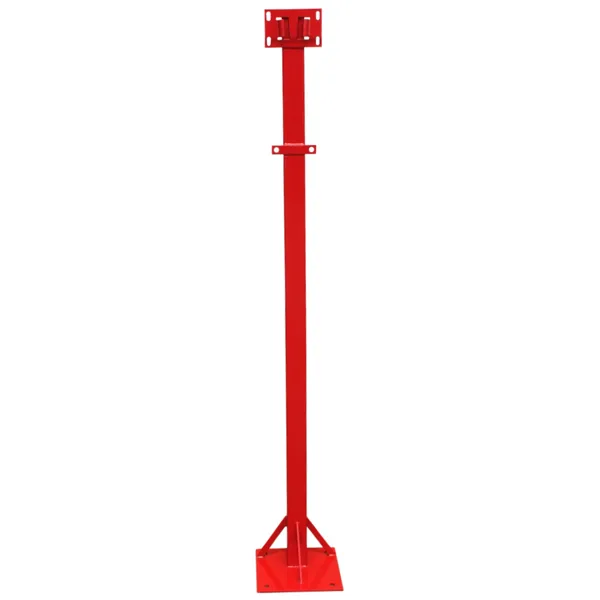
Floor stand
Use a floor stand. The reel mounts on a welded steel post bolted through a gusseted baseplate.
This covers car parks, open plant areas and walls that will not take the load. The gussets hold the post rigid, so the drum still turns cleanly when someone re-reels the hose.
A post that flexes makes re-reeling difficult. Hose that is hard to re-reel gets left on the floor.
Check before you order: the slab must take four anchors, and the position must stay clear of vehicle paths.
Surface cabinet or cover
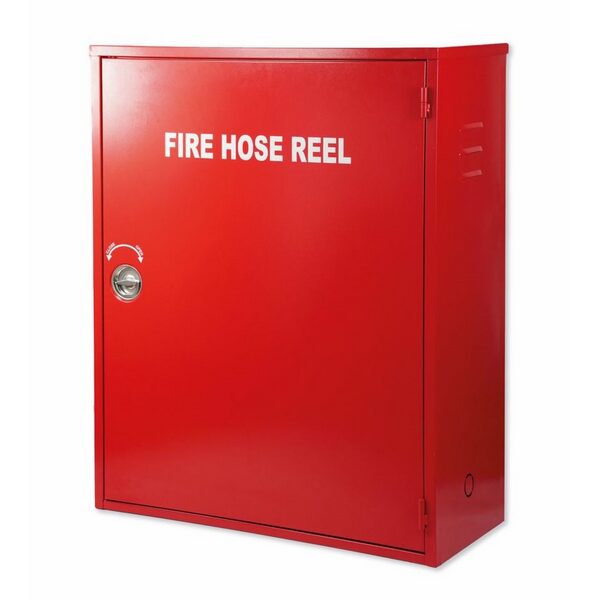
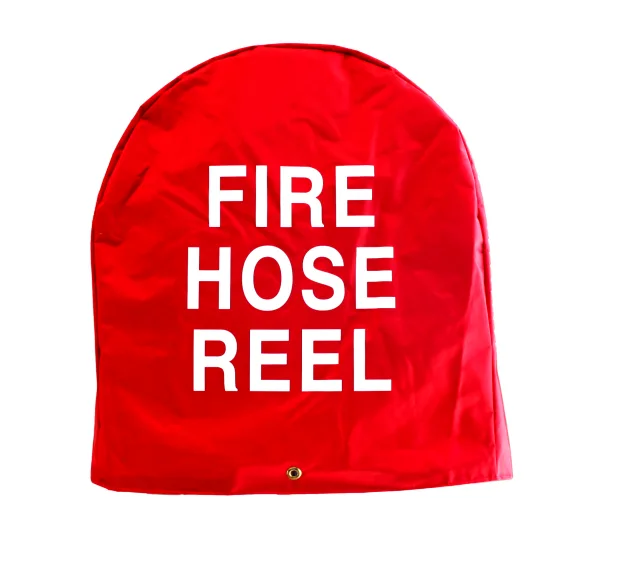
Use a cabinet where impact is the risk. Use a cover where weather and dust are the risk.
A steel cabinet suits loading docks, plant rooms and external walls. It also discourages the crew from borrowing the hose for wash-down, which is the most common cause of early hose failure.
A cover is the lighter option. It lifts off in one movement and secures through a metal eyelet so wind cannot take it.
Check before you order: the enclosure must not obstruct the hose or the isolation valve. Test it before sign-off.
Recessed cabinet
Use a recessed cabinet. It sits in the wall cavity so the door finishes flush with the wall face.
A surface cabinet projects about 350mm into the corridor. In a fitout working to a set circulation width, that 350mm is the whole argument.
The cabinet is 250mm deep. It needs a stud cavity or a bulkhead detail, and it does not retrofit into a solid core wall without structural work.
Check before you order: confirm the wall build-up on the section drawing, not the floor plan.

WATER SUPPLY
Pipework, Pressure and Commissioning
Follow these rules at installation:
- Connect the reel to the water main with rigid pipe. Do not use flexible hose.
- Use DN25 pipe as the minimum size to the reel.
- Fit a DN25 isolation valve at the reel.
- Keep the valve within reach of the operator, and keep it clear of the cabinet door.
- Protect the pipework and the reel from mechanical damage and from temperature extremes.
Confirm the available flow and pressure before construction starts. If the main cannot deliver the required flow while it holds the required running pressure at the reel inlet, the system does not comply. The reel is not the problem in that case, and no reel will fix it.
The fix is a storage tank and a booster pump. That adds capital cost, plant space and program time. Find this out at design stage, not after the walls close.
Commission every reel. Record the flow and the pressure measured at each one. Keep the record. That record is the baseline for every AS 1851 service that follows. A system with no baseline is a system nobody can prove was ever compliant.
SERVICE
Service, Testing and Records
AS 1851 sets the routine service for a fire hose reel system:
- A six-monthly inspection and service.
- An annual service with a flow test.
- A written record of every inspection, test and defect.
The annual flow test does the real work. It shows that the reel still delivers a usable stream, rather than that it still looks serviceable on the wall. AS 1851 separates critical defects from non-critical defects, and a critical defect stops the system from doing its job. Both categories appear on the report, and both need a response.
Keep the records. They support the annual fire safety statement, and they are the first thing an investigator asks for after an incident.
The defects technicians record most often
| Defect | Usual cause | Fix |
|---|---|---|
| Nozzle blocked or seized | Grit, corrosion, long periods without use | Replacement nozzle |
| Hose split, kinked or perished | Wash-down use, UV exposure, dragging over a sharp edge | Replacement hose |
| Valve weeps or will not open fully | Worn seat, corrosion, paint on the lever | Valve service or replacement |
| Access obstructed | Stock, pallets, parked plant, fitout works | Clear the area and mark the floor |
| Sign missing or painted over | Repaint, refit, tenancy change | Location sign |
| Reel weathered or corroded | No enclosure on an external wall | Cover or cabinet |
Most of these cost little at the six-month service. All of them cost more to explain on a fire safety statement.
Our breakdown of fire equipment testing intervals covers the full schedule and the NSW enforcement position behind it.
One habit causes most of the damage
A fire hose reel is fire equipment. It is not site plumbing. Wash-down use wears the hose, hides developing faults, and leaves the duty holder exposed on the maintenance obligation. Put a hose tap where the crew needs one, and the problem stops.
IN AN EMERGENCY
Before You Open the Valve
Two checks come before the valve:
- Raise the alarm and start the evacuation procedure.
- Confirm that the fire is a Class A fire.
Water is the wrong agent for two common fires. Do not use a hose reel on energised electrical equipment. Do not use a hose reel on burning flammable liquid, because water spreads the fuel. Both cases need a portable extinguisher instead.
This is why signage and induction training sit alongside the hardware, not after it. Our guide to fire hose reel rules and use sets out the full operating sequence and the five breaches auditors find most often.
READ MORE
Related articles from our blog
FREQUENTLY ASKED QUESTIONS
Still working out your coverage?
Check Your Coverage Before an Auditor Does
Floor plates change. Racking moves, tenancies subdivide, and a reel that covered the whole level in 2019 may now leave a corner short. That gap stays invisible until someone measures it.
We supply, specify and position fire hose reel systems for construction, industrial and commercial sites across Australia. Send us your current floor plan. We will mark up reel positions against AS 2441 coverage, show you where you are short, and quote what fills the gap.