

How to Choose the Right Wireless Alarm System
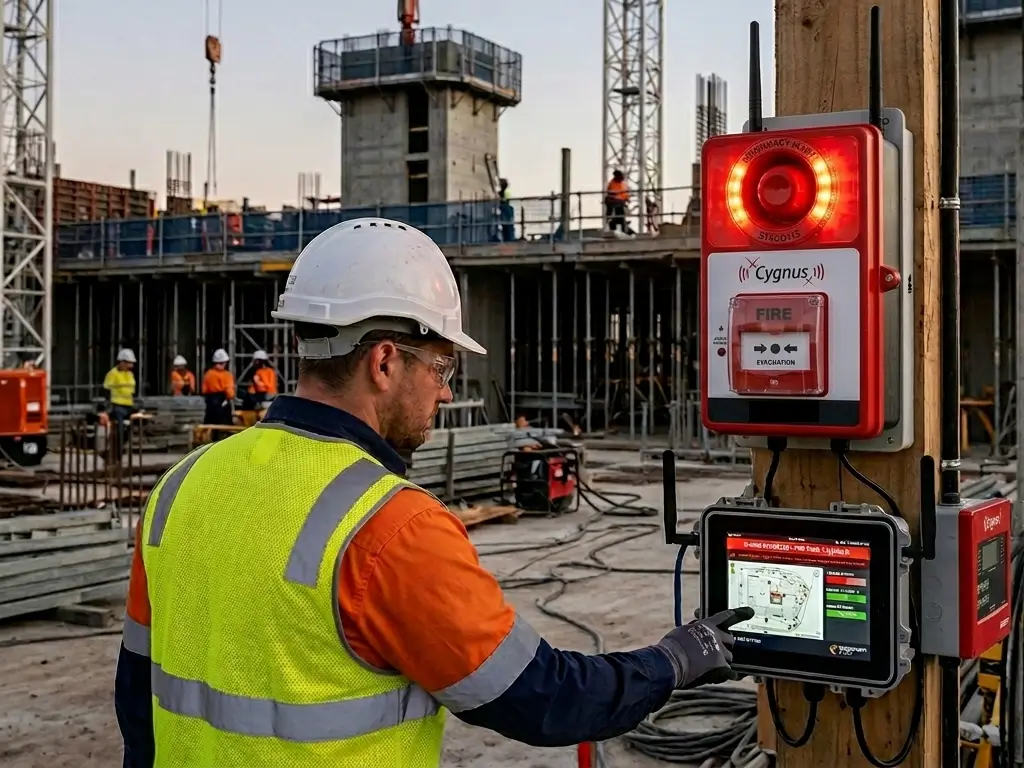
Wireless emergency alarm systems have become one of the most significant advances in workplace safety equipment in the past decade. For construction sites, industrial facilities, remote worksites, and temporary installations where running a hardwired systems is impractical, wireless systems offer reliable and compliant emergency alerting without the cost or complexity.
This guide covers everything safety managers, project managers, fire designers, and facilities teams need to know about wireless emergency alarm systems in Australia, how they work, what Australian standards apply, which environments they suit best, and how to select the right system for your site.
What Is a Wireless Emergency Alarm System?
A wireless emergency alarm system is a network of battery-powered or rechargeable devices, including sirens, strobes, evacuation triggers, and control units. They communicate with each other via radio frequency (RF) without requiring fixed cabling. When a trigger is activated (manually by a worker, or automatically by a detection device), all connected alarm devices activate simultaneously, providing site-wide alerting.
Modern wireless systems such as the Cygnus SiteProtect and Orisent platforms used by Checkpoint Group operate on licence-free ISM bands and use mesh networking protocols that allow signals to propagate across large or complex sites.
The systems are self-healing, if one device goes offline, the network routes signals around it, making them significantly more resilient than linear wired systems on dynamic worksites.
How Wireless Emergency Alarm Systems Work
Each device in the network acts as both a node and a relay point. When an evacuation trigger is pressed, the signal propagates through the mesh to every connected siren simultaneously, typically within one to two seconds. The touchscreen control unit (TCU) logs the event, showing which device triggered the alarm, when, and from where.
Key Components
- Evacuation triggers: wall-mounted or standalone buttons that initiate a site-wide alarm
- Evacuation sirens: high-decibel audio devices with integrated strobe lights for visible warning
- Touchscreen Control Unit (TCU): the central monitoring hub; logs events, shows device status, manages alarm zones
- Nurse call triggers: wearable or fixed devices used in aged care and healthcare for individual distress alerting
- Fire detection integration: connection points for smoke detectors, heat detectors, or manual call points
- Cellular-enabled devices: models with built-in SIM cards that can send alerts to remote supervisors via SMS or app

Battery Life and Power
Wireless emergency devices typically run on rechargeable lithium-ion batteries with operational life of 6 to 18 months depending on transmission frequency and environment. Dedicated battery chargers and power adapters are available for high-frequency deployment environments. The self-monitoring nature of quality systems means low battery warnings are automatically transmitted to the control unit before devices go offline.
Where Are Wireless Emergency Alarm Systems Recommended For
| Application | Why Wireless |
| Construction Sites | WHS Act requires emergency warning capability; wired systems impractical in dynamic environments |
| Tunnelling and underground works | Radio mesh networking handles signal propagation in enclosed, irregular spaces |
| Remote Worker and rural worksites | Cellular-enabled devices allow alerts to reach supervisors kilometers away |
| Industrial facilities with complex layouts | Wireless mesh overcomes structural barriers that limit wired signal range |
| Nurse Call - Aged care and healthcare facilities | Wearable nurse call triggers enable fast response without fixed call points |
| Heritage buildings where cabling is prohibited | No penetration of heritage fabric required for installation |
| Temporary and portable installations | No infrastructure investment required; fully relocatable |
| Large outdoor events and festivals | Rapid deployment with no cable infrastructure |
Australian Standards and Regulatory Requirements
NOTE: Information was accurate at the time of publication. Please check your relevant state regulatory requirements and applicable Australian Standards to ensure ongoing compliance.
AS 2220.1 & AS 2220.2 Emergency Warning Systems
These standards govern emergency warning systems in buildings. While they primarily address permanent building installations, wireless systems used in lieu of hardwired systems must achieve equivalent performance, including audibility levels, alarm response time, and device reliability.
AS 7240 Series Fire Detection and Alarm Systems
The AS 7240 series (adopting ISO 7240) covers fire detection and alarm systems. Wireless fire alarm systems must comply with AS 7240.25 (components using radio links) where they are used as part of a fire detection system. This standard specifies requirements for signal reliability, interference immunity, and battery monitoring.
Work Health and Safety Act 2011 (and State Equivalents)
PCBUs (persons conducting a business or undertaking) are required under the WHS Act to have effective emergency plans, which include means to alert all workers in the event of an emergency. On construction sites, this is typically enforced through SafeWork requirements for emergency procedures on high-risk construction work (HRCW) sites. Wireless alarm systems are a recognised means of meeting this obligation.
BCA / National Construction Code (NCC)
The NCC requires fire warning systems in most commercial and public buildings. In new construction, temporary wireless systems may be deployed during the construction phase prior to permanent systems being commissioned.
Cygnus SiteProtect vs Orisent: Choosing the Right System
| Cygnus SiteProtect | Orisent System |
| Best for large construction and industrial sites | Best for aged care, healthcare, and smaller facilities |
| Mesh networking up to 480 devices per network | Nurse call and evacuation in a single system |
| Long range, devices communicate up to 100m apart | Cellular-enabled devices for remote alert capability |
| Full event logging and reporting | Wearable triggers for mobile workers |
| AS 7240.25 compliant | Touchscreen Control Unit with SMS alerting |
For a full feature-by-feature breakdown of both platforms, see our Cygnus and Orisent wireless alarm systems page.
Maintenance and Compliance
Wireless emergency alarm systems require regular testing and maintenance to remain compliant and effective:
- Monthly functional test, trigger each alarm zone and verify all sirens activate
- Battery status check, most systems self-report; verify on TCU dashboard
- Annual inspection, inspect all devices for physical damage, confirm firmware is current, review event logs
- Replacement schedule, replace batteries or devices per manufacturer schedule
- Test records, maintain a logbook or digital record of all tests for SafeWork and insurance purposes
Why Choose Checkpoint Group?
Checkpoint Group is Australia's specialist supplier of wireless emergency alarm systems, stocking both the Cygnus SiteProtect and Orisent platforms along with a comprehensive range of fire safety, first aid, and emergency communication equipment. With proven installations on major Australian infrastructure projects, including the Sydney Metro, Melbourne Metro, Waterloo Metro Station, and Nepean Hospital.
Checkpoint Group brings extensive project experience to every deployment.
Our team can assist with system design, device selection, and commissioning support for projects of any scale. Contact us to learn more about wireless emergency alarms


